
Cambodia
QSA has been working with development partners in Cambodia since 1979, focusing on building food and water security and livelihoods, while also promoting the empowerment of women, the protection of children and other vulnerable groups, and environmental protection.
We currently support four projects in rural Cambodia. The following project summaries are from the QSA Annual Report 2025. These projects are delivered in partnership with the Australian Government through the Australian NGO Cooperation Program (ANCP).
Khmer Community Development (KCD)
Kandal Province
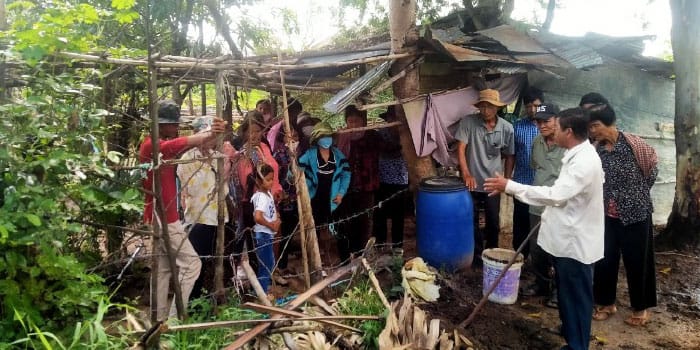
Training session on how to make compost and liquid natural fertiliser to villagers in Sangkat Prek Chrey. Photo credit: KCD
This three-year project emphasises community-driven development in nutrition, agriculture, gender equity, income generation, and environmental sustainability. By empowering target communities to identify their priority needs, KCD enables participants to implement successful projects that enhance livelihoods by supporting the establishment of home gardens and livestock raising.
Highlights across 2024-2025:
- 674 were trained on natural agricultural methods, income generation, business, and financial management. It focused on encouraging farmers to track their agricultural input costs and income. As a result, they reduced their input costs by around 50% while simultaneously increasing output.
- 40 villagers implemented new planting plans, selecting seasonal varieties, researching market demand, and using social media to promote their agricultural produce. They increase sales and generate more income via Facebook and other platforms, expanding into new markets and boosting earnings by up to $US75 per month.
A key feature of this project is the training of female leaders to enable them to conduct training and support community development. KCD recognised that men’s support is key to women’s success in implementation. One of the most interesting activities implemented by KCD this year was capacity-building sessions for men (villagers and local authorities) on gender.
This year, KCD began working on a new project designed specifically for vulnerable older women. In conjunction with local authorities, they identified a group of women, then they used forum theatre to surface information about their situations and issues, as well as to identify practical solutions to meet their specific needs. Going forward, they will be actively involved in designing, implementing, and managing practical support and activities to address their needs. This new co-design methodology will be applied to all KCD’s future community development work.
Bunrany Hun Sen Development Centre (BRHS)
Pursat Province
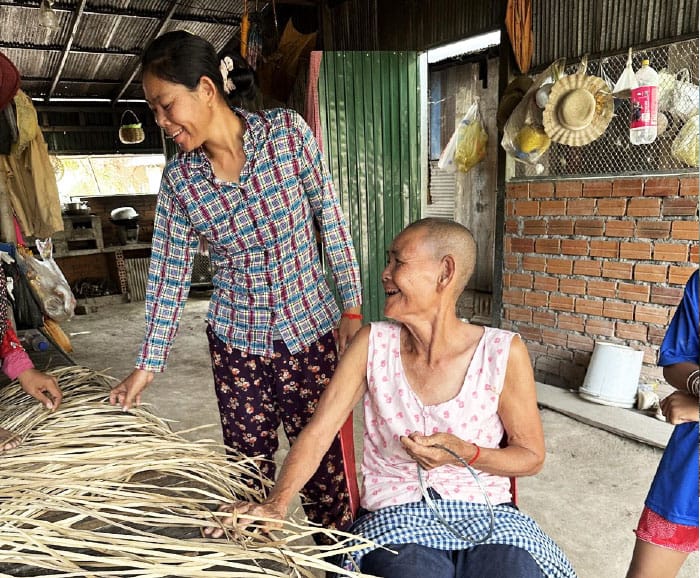
Training in grass mat weaving for older rural women Pursat, Cambodia Photo credit: BRHS
2025 marked the end of an era for one of QSA’s longest-standing projects when after around 27 years, the partnership between QSA and the Bunrany Hun Sen Development Center ended in early 2025.
QSA first provided limited funding in 1998 for this Center to undertake permaculture training, then in 2000 it supported facilities for training in food processing. When the Center then expanded into handicrafts training, QSA supported courses in sewing, fabric weaving, grass and cane mat weaving. Some of this training was conducted in Pursat, but training was also provided to isolated rural women who used local materials to create handicrafts for sale, generating income that reduced their reliance on climate-change susceptible agriculture.
By 2016, the Center increasingly focused on production and a commercial outlet in Pursat, while continuing to provide handicrafts training and to support
rural producers. However, in recent years, the Center faced marketing and sales challenges, especially during COVID. Recognising that change was necessary to ensure the Center’s survival, QSA supported initiatives to build capabilities and facilitate the transition to a more commercial, self-sufficient organisation.
In 2024, a new, more commercial business unit was established to identify new markets, build business capabilities, and achieve increased sales to make the Center self-sustaining. Work commenced on an online sales campaign to expand into new markets and drive new sales. QSA focused its support on the new enterprise unit and agreed on a plan to phase out funding as the Center became self-sufficient. Early in 2025, QSA terminated its financial support.
Many vulnerable rural women have received training or found employment through this long-term relationship. While other employment opportunities are developing in Pursat, the Center continues to operate its production and sales facility, providing skilled jobs and maintaining traditional designs and handicraft techniques.
QSA recognises that this transition will bring challenges. Still, we hope the Center continues to provide employment and training opportunities and maintains a retail outlet for local handicraft producers.
Department of Women’s Affairs (DWAKT)
Kampong Thom Province
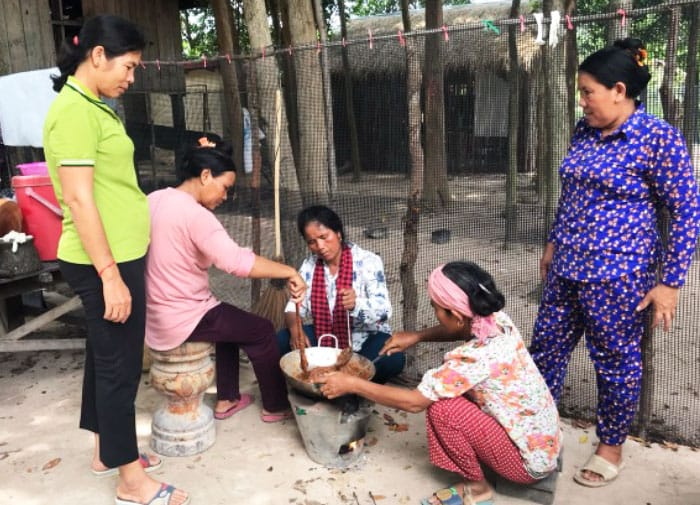
Training on gender mainstreaming in adaptation to climate change and disaster risk reduction for new farmers Photo credit: DWAKT
This project improves the lives of rural families through practical support for food and water security, household health, and women’s leadership. By combining sustainable agriculture with hygiene, sanitation, and rights awareness, it meets immediate needs while building long-term resilience.
Highlights across 2024-2025
- 60 farmers trained in permaculture established home gardens, improving household nutrition and food availability. Many earned AU$80–110 per month by selling surplus produce.
- Farmers trained previously received refresher coaching, helping maintain and expand climate-resilient farming practices.
- 29 households gained reliable access to water through pump wells and tanks for daily household use and garden irrigation.
- 60 households upgraded sanitation facilities, and 9 families with new toilets reported reduced health-related expenses.
The project also strengthened community wellbeing and safety:
- Training on domestic violence prevention, gender rights and child protection reached 120 households.
- 60 parents improved their understanding of child protection.
- 81 women commune members and 14 provincial/district officials built skills to advocate for women’s and children’s rights.
Women’s leadership was a notable achievement. Trained commune leaders now play a more active role in supporting survivors of domestic violence, while collaboration with local committees has helped integrate gender equality into planning for climate adaptation, disaster preparedness, and local economic development.
Department of Women’s Affairs (DWAP), Pursat Province
Training on permaculture and climate change Photo credit: DWAP
This project has played a crucial role in enhancing food security, empowering women, and facilitating community adaptation to the effects of climate change. Eighty women farmers were trained in permaculture and have now established home food gardens that provide reliable year-round nutrition. Many have also participated in small business training, enabling them to earn additional income by selling surplus produce and raising animals.
In addition, 80 farmers who received permaculture training last year were supported to ensure the ongoing benefits of implementing these new techniques.
The focus on climate-smart agriculture is particularly significant in areas that rely on a single monsoon rice crop. With weather patterns becoming more unpredictable, these communities face increasing risks from droughts, floods, and rising temperatures. Training in drought-resistant crops, irrigation, and water management, as well as food storage, has helped reduce dependence on crops that are vulnerable to these climate stresses.
The program has also yielded broader benefits within communities. Farmers now have a better understanding of climate change and strategies to lessen its impacts. Families report improved hygiene and sanitation practices, contributing to better health outcomes. Awareness of gender rights, domestic violence, trafficking, and migration has also increased.
Local leadership has been strengthened, with women in elected village and commune roles gaining greater confidence and skills to carry out their responsibilities. Kindergarten teachers have received training on child rights, protection, and nutrition, while provincial and district staff from the Department of Women’s Affairs have participated in leadership and safeguarding training.
To address issues of violence and exploitation, a workshop was held for 360 representatives from commune councils, police officers, village leaders, and safeguarding officers. This provided a forum to discuss the protection of women and girls and the prevention of unsafe migration, trafficking, and domestic and sexual violence.

QSA acknowledges the support of the Australian Government through the Australian NGO Cooperation Program (ANCP).

QSA has signed onto the Australian Council for International Development Code of Conduct See www.acfid.asn.au for details.

QSA’s policies
If you would like to understand more about QSA’s approach to its development work, this website shows you some details of the various projects currently being supported, and for the theory behind …
If you have a grievance, complaint or dispute find out about our procedures here.